Fundamental mechanisms of metastastic dissemination
The metastatic dissemination of tumor cells is a critical step in cancer progression that greatly impacts patient treatment and survival. To date, there are no effective therapies specifically targeting the metastatic spread of tumor cells. To better understand the molecular and cellular mechanisms of tumor dissemination while avoiding biases inherent to experimental model systems, we base our studies on tumor explants directly obtained during surgeries from a large number of patients (“bedside-to-bench”).
We aim to answer the following questions:
✓ How do cancer cells acquire their migratory properties?
✓ Do they use one or multiple strategies to move?
✓ Is it possible to halt the machinery responsible for their spread?
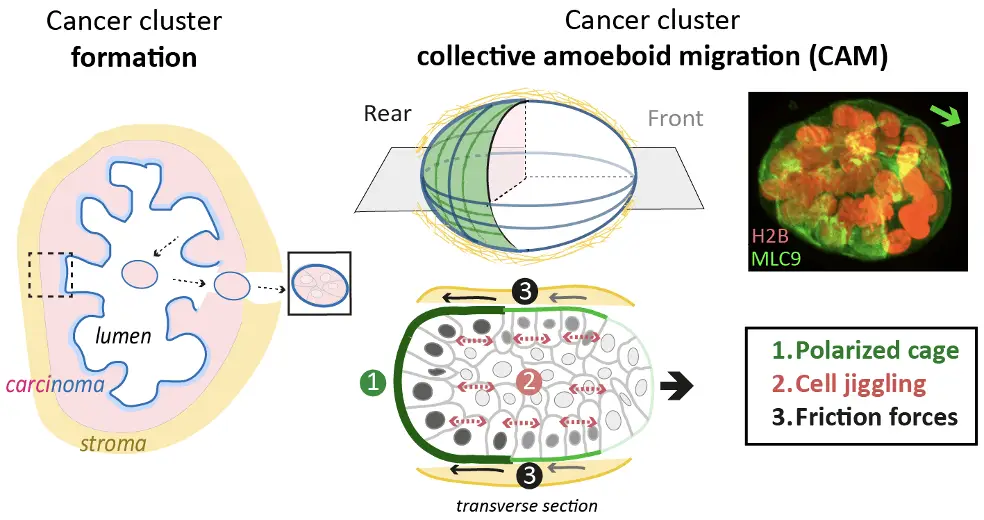
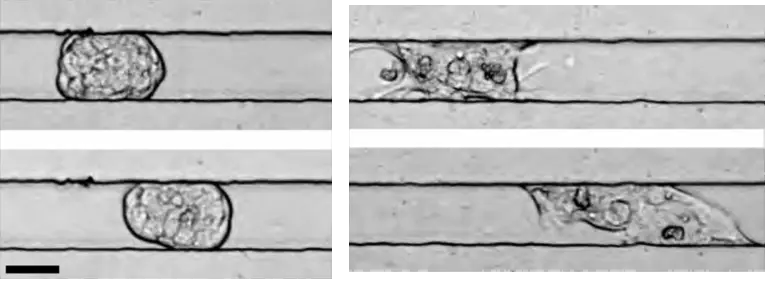
Patient explants have revealed that collective behaviors predominate in the invasion and dissemination of digestive carcinomas and that their progression is not always associated with the loss of epithelial differentiation and apico-basolateral polarization, enabling undescribed mode of cell migration.Our previous studies led us to challenge the current knowledge on the fundamental principles of cell migration, which ranged between 3 main mechanisms: independent cell migration is fuels by an adhesion/traction mechanism (e.g. fibroblasts) or propulsion/friction modalities (amoeboid, e.g. immune cells). Collective migration had to date only been seen as a adhesion/traction mode of motility. The analyses of primary explants enabled us to draw the hypothesis that there is a fourth mode of cell migration corresponding to a collective mechanism of migration by propulsion/friction, that we named collective amoeboid migration (CAM). To answer this question we have established collaborations with three laboratories with expertise in biophysics (Matthieu Piel & Mathieu Coppey (Curie), Raphael Voituriez (Sorbonne).
3 minimal requirements for CAM were determined :
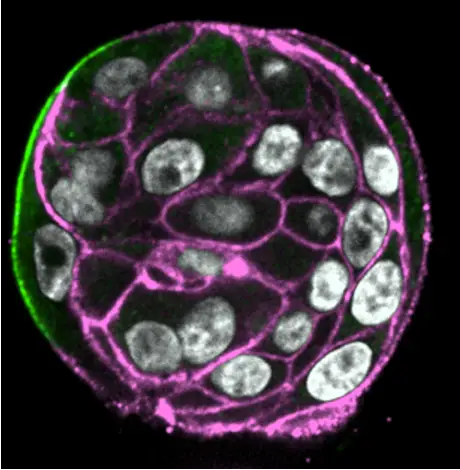
Cell clusters need to polarize a supracellular actomyosin network which defines the rear,
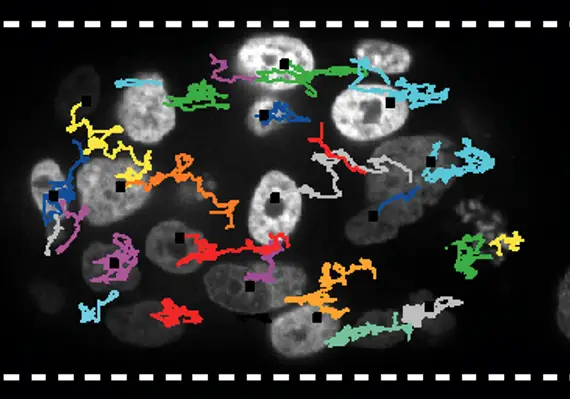
Cell clusters must behave as a solid in which cells jiggle, i.e oscillate around a fixed position within the group,
The jiggling needs to be strong enough to generate friction forces on the substrate to self-propel the cluster to the opposite direction.
We are now specifically investigating the fundamental mechanism underlying those biophysical properties of CAM and the contribution of CAM to digestive cancer metastasis.
Molecular and Cellular Determinants of CAM
Front-Rear polarity of tumor clusters
How do indivual cells coordinate their response to symmetry breaking cues to define the supracellular front -rear polarity axis of the tumor cluster?
Leader/Follower hierarchization
Are the cells at the Rear and Front of the clusters really the followers and leaders, respectively? What are their functions? Are they predetermined to fulfill their function?
Biomechanics of tumor cell clusters during CAM
Solid/liquid state of tumor clusters
CAM is fueled by the polarized jiggling of cells stuck in a solid state (Glass-like, no neighbors exchanges). We hypothesize that in contrast to adherent systems, tissue fluidization will inhibit the collective migration of clusters undergoing CAM in confined non-adhesive environments. We have established a collaboration with Giorgio Scita (IFOM, Italy) to address this exciting area of investigation
Mechanoresponse of tumor clusters to external forces (compression, shear-stress) during dissemination
How do individual cells within the cluster coordinate their response to applied forces to induce cluster movement? Which molecular pathways are involved? As a collaboration with the labs of Jacky Goetz and Gregory Giannone, the METAGREG program will combine biophysical approaches and a variety of invasion approaches from microfluidics to animal models (Zebrafishes, mice).
Plasticity of collective cancer invasion
Determine the cell autonomous and non-autonomous mechanism of collective plasticity.
Preliminary data showed that similar to individual cells, clusters are plastic and alternate between traction and propulsion-based mode of collective migration.
CAM and metastatic dissemination
Using ex vivo and in vivo models, we will investigate whether CAM is more efficient at spreading cancer than traction-based collective migration.

 Français
  English